

THE BIWEEKLY BRIEFING · 8 MIN READ
Giga-project, government, state-owned or private: four different clients, four different rulebooks. What each one means for price, people and cash, and what to settle before you bid.
IN THIS ISSUE
01 From the editor
02 Four clients, defined
03 How each client buys and contracts
04 Risk, approvals and payment
05 What an assumed single model costs
06 Pre-bid checklist
—————— ◆ ——————
FROM THE EDITOR
This issue is very different…
Not only because it is one day late, but because the whole issue is dedicated to one topic: the question I am asked more than any other by people and firms entering the Kingdom. Who is the client, and what does that change?
It compares the rules and does not rank the clients
Each path is workable, and each has a price. I have worked with all of them, and this is what I can tell you
My apologies for not publishing it on Sunday
Thank you for your understanding
Walid Freiha
—————— ◆ ——————
THE ISSUE
Know your client
In Saudi Arabia, "the client" is not one market. Giga-project developers, government entities, state-owned companies such as Aramco, and private developers each set their own procurement route, contract terms, approval path, risk allocation and payment behavior.
A firm that prices and resources them as one market carries the cost of the difference itself.
The owner does not…
—————— ◆ ——————
02 · FOUR CLIENTS, DEFINED
The “client” is not one single category
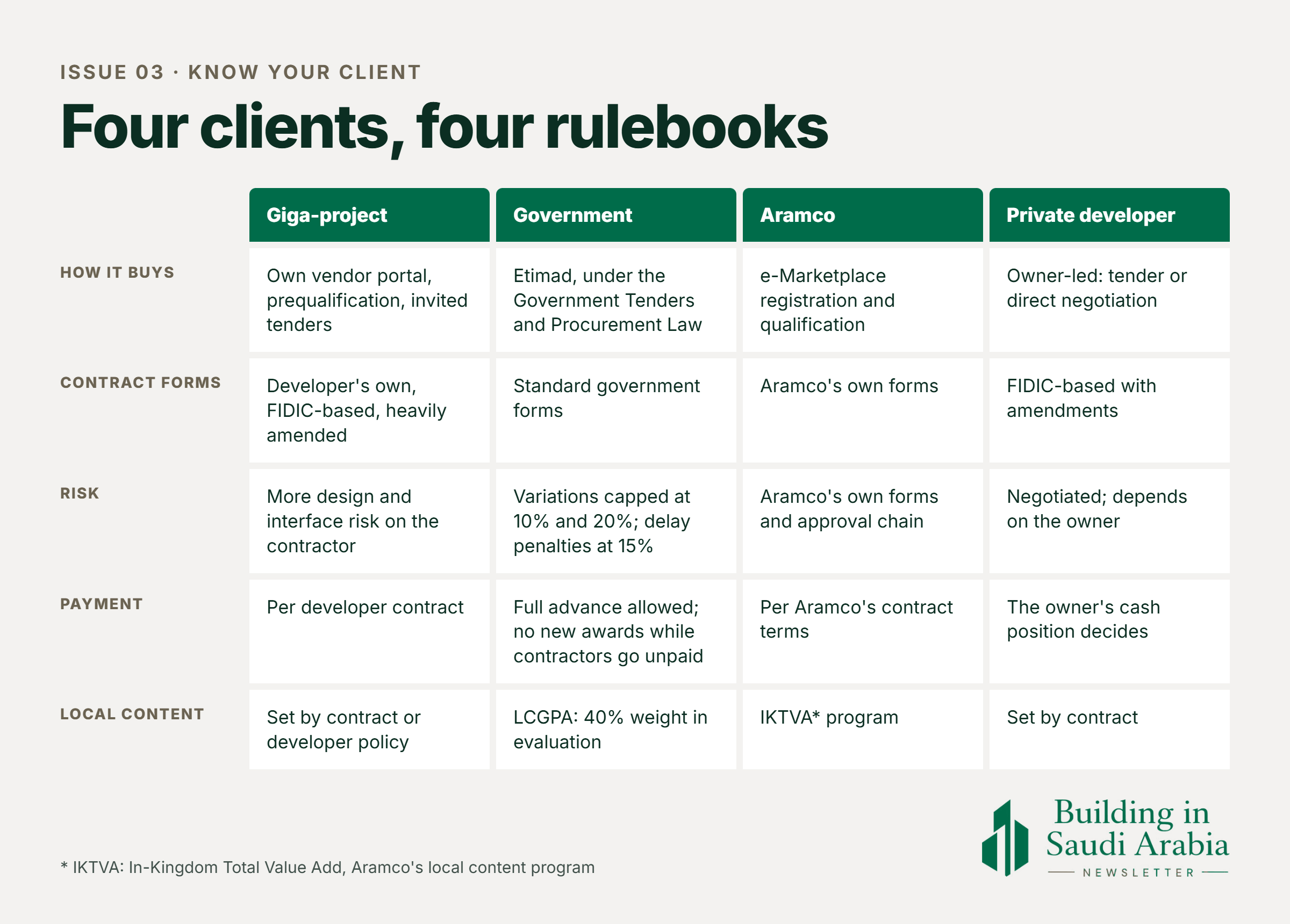
Tap the chart to enlarge
A contractor or consultant bids on a project. It also bids on a buyer. The buyer decides how the work is tendered, which contract form governs it, who approves a variation, and when cash arrives. When a firm assumes these are the same across buyers, the error does not show in the bid. It shows later, in the cash flow, the claims file and the staffing plan.
Over 25 years I have worked for most kinds of client, and on the client, consultant, PMC and contractor sides. The same firm can be profitable with one buyer and lose money with the next on near-identical scope, because the terms, not the work, decide the outcome.
The test for a separate category is whether the buyer has its own procurement system, its own approval path and its own conditions for suppliers. Aramco meets that test. It runs its own supplier registration and qualification and its own local content program, IKTVA*. It is state-owned, but it is not a government entity buying under the public procurement framework, and it is not a single-project developer. Folding it into either group would hide differences that matter to a bidder.
Other state-owned companies may follow their own rules or an Aramco-like model. This issue does not assume either. It uses Aramco as the case and does not generalize from it. It names categories, not projects. An entity is named only where its own published rules support the point.
* IKTVA: In-Kingdom Total Value Add, Aramco's local content program
CLIENT 01
Giga-project developer
A company set up by the state, usually PIF-owned, to master-plan, build and often operate a single destination or city. It acts as both master developer and client: it owns the land, sets design and procurement standards, and lets packages to consultants and contractors through its own procurement function and contract forms.
Giga-projects have no single procurement rulebook. Each developer sets its own, and a bidder should establish the rules for each one before bidding.
In my experience, no two developers run the process the same way. Some have their own procurement department. Others run it through a central commercial team, or hand it to a project management consultant. The common pattern is registration on the developer's own vendor portal, prequalification by discipline and value band, and invited tenders to prequalified firms rather than open public tenders, increasingly with early contractor involvement before the price is fixed. Contract forms are the developer's own, often FIDIC-based with heavy amendments.
CLIENT 02
Government entity
A ministry, authority or agency bound by the public procurement framework: the Government Tenders and Procurement Law and its executive regulations. A new version of the law was published in September 2026 and takes effect in January 2027, replacing the 2019 law. Its executive regulations have so far been published only in draft for consultation.
CLIENT 03
State-owned company
A company owned by the state that runs its own procurement system. Aramco is the main case. It requires every company supplying goods and services to register. Registration and qualification differ by location and by supplier type: material vendor, manufacturer or service provider. Aramco states that registering and qualifying does not guarantee future business.
CLIENT 04
Private developer
Procurement is set by the owner and the project. There is no common rulebook. The terms are whatever the owner has negotiated.
—————— ◆ ——————
03 · PROCUREMENT
How each client buys and contracts
GOVERNMENT
SAR 1M direct procurement threshold
Tenders are published, evaluated and awarded through Etimad, the Ministry of Finance's electronic platform. The new law changes the mechanics. It combines the bid-opening and bid-evaluation committees into one. It raises the direct procurement threshold to SAR 1 million. It lets limited tendering cover liberal professions. It changes bid validity from 90 calendar days to 90 working days, and shortens the minimum standstill after award from five working days to three. The Ministry of Finance's review of contracts before signing drops from 15 working days to four. The standard contract forms will follow the new executive regulations, which are still in draft.
ARAMCO
A bidder first registers through Aramco's e-Marketplace platform. A Saudi-based company must supply a long set of documents. They cover its corporate, tax and banking position and, for service providers, its contractor classification. Foreign companies register through the Aramco affiliate for their region. Participation in the IKTVA* program follows. Aramco's "Doing Business with Aramco" guide covers registration, qualification, IKTVA* and its procurement policies.
GIGA-PROJECTS
Each developer runs its own procurement. In my experience, prequalification, supplier registration and contract forms differ from one developer to the next, so a firm qualified with one starts again with the next.
PRIVATE DEVELOPERS
Procurement is owner-led and varies with the owner's size. Larger developers run competitive tenders through an in-house team or a PMC. Smaller ones often negotiate directly with contractors they already know. In my experience, contracts are commonly FIDIC-based with amendments.
—————— ◆ ——————
04 · RISK, APPROVALS AND PAYMENT
Who carries design and delay risk, and who approves what
The same contract label can carry different risk. The amendments matter more than the base form. A firm should read the particular conditions before it reads the price schedule.
GOVERNMENT
10% - 20% variation limits
Under the new law, new items can add up to 10% of contract value and existing items can grow by up to 20%. The delay penalty cap falls from 20% to 15% for works and services. Approvals follow each entity's own delegation of authority.
ARAMCO
Risk allocation follows Aramco's own contract forms, and variations go through its own approval chain.
GIGA-PROJECTS
Risk allocation follows each developer's own forms, and in my experience those forms push more design and interface risk to the contractor than a standard FIDIC would. Design-and-build packages are common. Variations go through the developer's approval chain, often with a PMC reviewing before the developer signs.
PRIVATE DEVELOPERS
Risk is negotiated and depends on the owner's appetite. Approvals usually run through a small owner team or a single decision-maker, which can make them faster than with institutional clients, but less predictable.
Payment, balance sheet and local content
Payment is where the difference between clients reaches the balance sheet.
Government. The executive regulations govern advance payment. The new law permits full advance payment under those regulations, and the regulations exempt some cases from the bank guarantee requirement. The law also bars an entity from issuing a new award where contractor payments are outstanding and the entity has not acted after notification by the Ministry of Finance, subject to exceptions. The Ministry of Finance presents the law as supporting timely payment. That is a stated aim, and there is no published data yet on how it works in practice.
Aramco, giga-projects and private developers. Payment periods, advance payment, retention and certification follow each contract. Aramco's payment terms are set in its own contract forms. Giga-project payment terms are set by each developer's contract and funding arrangements. Private developers range widely, and the owner's cash position matters more than the contract wording.
The working capital each path requires follows from these terms. A firm should model cash by client: the bank guarantees it must post, the retention it carries, the time from certification to cash, and the cost of financing a variation dispute. As a rule of thumb, the client that pays most predictably is often not the one with the best headline terms.
LOCAL CONTENT DIFFERS BY PATH
40% local content weight in public evaluation
Government. The Local Content and Government Procurement Authority sets the preference mechanisms. They include a 10% price preference for national products against foreign products, an additional preference of up to 20%, a mandatory list of national products, and a local content score. The score carries a 40% weight in evaluation against 60% for price, and applies to high-value contracts except sourcing contracts. From April 2027 the same weighting extends to management consulting and IT services.
Aramco. The IKTVA* program applies to suppliers. Aramco states its aim as supply-chain efficiency and the development of a competitive energy sector in the Kingdom. Its "Doing Business with Aramco" guide sets out what suppliers need to meet.
Giga-projects and private developers. In my experience, local content requirements are set by contract or by the developer's own policy, and vary from project to project.
—————— ◆ ——————
05 · THE COST OF GETTING IT WRONG
What an assumed single model costs
Four errors recur when a firm assumes one model
01 · UNDERPRICED RISK
A firm prices a variation-heavy job on one owner's terms, then finds that another owner's contract moves design risk to the contractor
————————
02 · THIN CASH BUFFERS
A firm sizes working capital on one payment pattern and meets a different one
————————
03 · THE WRONG TEAM
A firm staffs for one approval path and finds the next one needs different people, different paperwork or a different local content position
————————
04 · MISSED QUALIFICATION TIME
Aramco registration and government prequalification take time; a firm that starts them at bid stage is late
Patterns I have seen repeat:
Giga-project. A contractor wins on price, then finds that the interface risk with other packages is its own, with no time relief when a neighboring contractor runs late.
Government. A firm prices to the tender, but the award takes months longer than planned, and the bid team and bank lines sit idle while it waits.
Aramco. A capable international firm starts registration and IKTVA* certification when the tender appears, and misses the bid.
Private developer. A firm accepts generous headline terms, then carries months of unpaid certified work when the owner's sales slow.
The context is a large and mixed pipeline. Firms entering or expanding in the Kingdom often meet more than one client type in the same year.
—————— ◆ ——————
06 · PRE-BID CHECKLIST
Before price, people and cash are committed, answer three questions.
1 Which client type is this? Which rules and which contract form apply, including the amendments?
2 What does it require? Check balance sheet and working capital, guarantees and retention, local content position, staffing, and tolerance for variation, claims and delay
3 What must be in place before bidding? Check registration or prequalification, local content certification, bank lines and the named team
The decision that follows is which client types to pursue, in what order, and with what resources.
The answer will differ by firm. Reach it by testing each bid against the rules of the specific client, not against an average of the market.
—————— ◆ ——————

Walid Freiha
Architect and Real Estate Executive
Riyadh, Saudi Arabia
